Most leaders don’t use the feedback sandwich because they’re trying to be fake. They use it because they’re trying to be kind. That instinct isn’t wrong. Delivering criticism is uncomfortable, and surrounding it with positives feels like the humane thing to do.
The problem is that kindness and clarity are not the same thing. The feedback sandwich prioritizes the comfort of the person delivering the message, not the growth of the person receiving it. And most employees have seen it enough times that they’ve learned to brace for it. The compliment lands. Then comes the “but.” At that point, the opening praise is already forgotten, the criticism lands without context, and both people leave the conversation feeling vaguely off.
This is a communication habit that mistakes discomfort management for leadership.
The feedback sandwich corrupts trust over time
In case you haven’t heard of it, here’s how the feedback sandwich works:
- Open with praise
- Deliver criticism
- Close with praise.
The intention is to soften the blow. In practice, it creates three compounding problems.
It trains people to distrust praise. When positive feedback consistently precedes criticism, employees learn to hear encouragement as a warning signal. The compliment stops functioning as recognition and starts functioning as a setup. Over time, that response poisons even genuine praise.
And once people learn “praise = incoming critique,” you’ve created a tax on every positive moment. They spend mental energy decoding you instead of absorbing recognition.
It buries the message. Roger Schwarz, writing in HBR, found that sandwiching criticism between praise undermines both the feedback and the relationship because it blurs what actually needs to change. When a receiver is sorting through mixed signals, they’re focused on decoding, not improving.
It signals a lack of confidence. When criticism requires strategic packaging to be delivered, people notice. It communicates that the leader is more invested in managing the room’s emotional temperature than in helping someone grow. Ben Horowitz called it accurately when he described the feedback sandwich as a “shit sandwich.” The structure protects the deliverer, not the receiver.
Poor feedback shuts down the brain before the message lands
The premise behind the feedback sandwich is real. Feedback, done poorly, genuinely does feel threatening. But better packaging is not the solution.
NeuroLeadership Institute research shows that receiving feedback can trigger the same stress response as a physical threat. When that happens, people don’t become more open to learning. They become more defensive, more avoidant, or more performative. The drive to protect status overrides the capacity to absorb information. If your feedback format activates a threat response, the content almost doesn’t matter. The receiver isn’t in a state to use it.
Essentially, feedback isn’t just a communication moment. It’s a biological event.
David Rock’s SCARF model identifies five domains that trigger that response: Status, Certainty, Autonomy, Relatedness, and Fairness. The feedback sandwich manages to threaten several at once. Mixed signals destroy Certainty. Criticism wrapped in false praise damages Relatedness and Fairness. Vague expectations leave Status in limbo. The format designed to soften feedback is neurologically primed to make it harder to receive.
Effective feedback does the opposite. Specificity restores Certainty. Separating behavior from character protects Status. Asking about intent preserves Relatedness. None of that requires softening the message. It requires structuring it so the receiver’s brain can actually engage with it.
Replace the sandwich with two better frameworks

Radical Candor
Kim Scott’s Radical Candor framework starts from a premise most leaders agree with in theory but struggle to execute: The best feedback comes from people who genuinely care and are willing to be honest. Scott describes it as the intersection of “care personally” and “challenge directly.”
Care without challenge produces what Scott calls ruinous empathy — leaders avoiding hard conversations to protect feelings, and in doing so, failing the people they’re trying to help. Challenge without care produces aggression, not development. The sandwich is a textbook case of ruinous empathy. It looks kind. It feels kind. But it prioritizes the leader’s comfort over the employee’s clarity.
Radical Candor requires that praise be specific, sincere, and delivered close to the moment it happened. Not as packaging, not as strategy, but as standalone recognition that tells someone exactly what they did well and why it mattered. Criticism should be direct, grounded in observable behavior, and tied to a clear path forward.
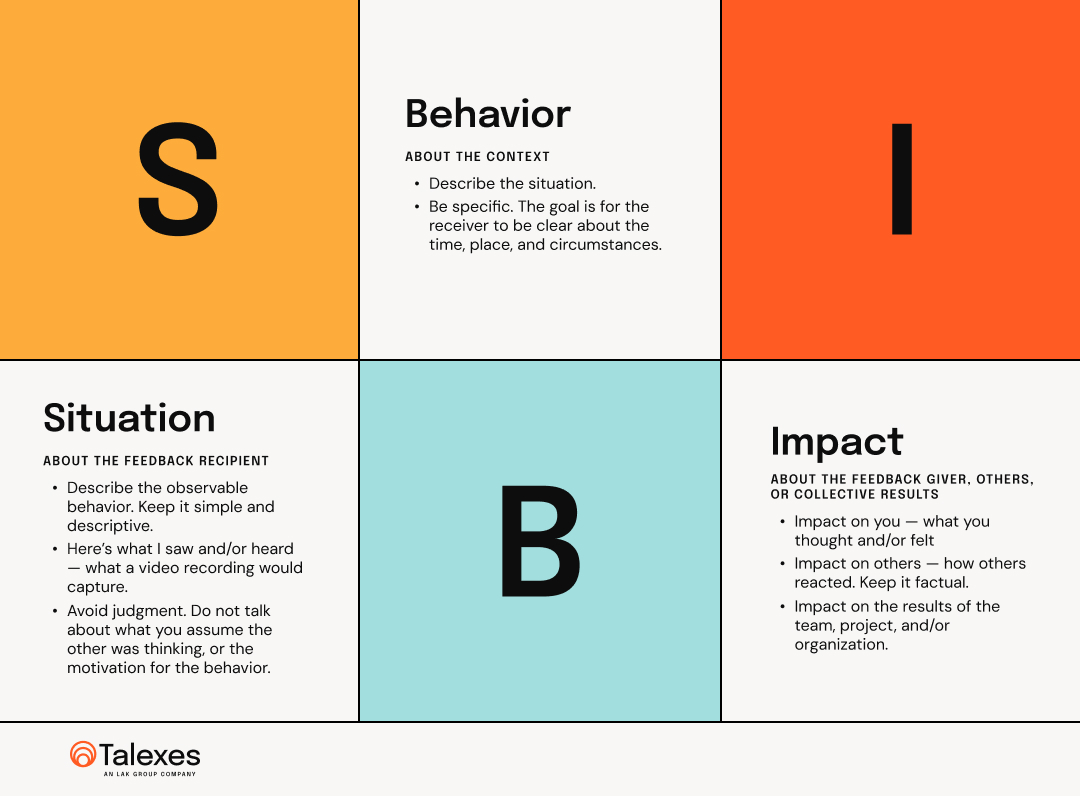
The SBI Model
Radical Candor describes the mindset. SBI gives it structure.
The Center for Creative Leadership’s SBI model — Situation, Behavior, Impact — is a proven framework for feedback that stays grounded in specifics and avoids the generalizations that trigger defensiveness. SBO extends it by replacing Impact with Outcome, which adds a critical layer: checking intent and setting a clear expectation, not just naming the consequence.
Situation. Name the moment precisely. Not “you always do this” but “in yesterday’s client review.” Specificity anchors the conversation in something real and reduces the instinct to get defensive.
Behavior. Describe what was observable — what the person said or did — without labeling their intent or personality. Staying behavioral keeps the feedback factual rather than personal.
Impact. This is where most feedback conversations fall short. Impact has three parts: name the outcome, check intent, and set a clear expectation. Naming the outcome helps the receiver understand why the behavior matters. Checking intent (“What was going on for you in that moment?”) turns a verdict into a conversation and often surfaces context you didn’t have. Setting a clear expectation removes ambiguity about what better looks like.
SBI and radical candor in practice
SBI is even more powerful when combined with radical candor. Below is an example of what the dual-pronged approach looks like in practice.
“In Monday’s team meeting (Situation), you jumped in and answered twice when the question was directed to Sam (Behavior). Sam disengaged, and we missed his context, which slowed the decision (Outcome/Impact). What was going on for you in that moment (Outcome/Intent)? Going forward, I want you to pause and let him answer first, then add your perspective after (Outcome/Expectation). I can give you a cue in the meeting until it becomes habit if that’s useful (Outcome/Support).”
Direct. Specific. No sandwich required.
And sometimes, a moment like this is not just a one-off. It is part of a broader pattern in how someone communicates, responds under pressure, or shows up on a team. In those cases, assessments can be useful, not as a replacement for direct feedback, but as a way to give leaders more context. They can help surface tendencies, strengths, or blind spots that make coaching more specific and development more targeted over time.
How to start this week
Shifting away from the feedback sandwich is a practice, not a policy change. Here’s how to build it into your next week.
- Deliver praise on its own. Find one behavior worth recognizing, name the situation, describe what you observed, say why it mattered, and stop. No “but” attached. Let the praise be the whole conversation.
- Use SBO for your next correction. Resist the instinct to open with a compliment. Start with the situation, describe the behavior, name the impact, ask about intent, and set a clear expectation. Keep your tone steady and your message clean.
- Check your intent before the conversation. Ask yourself: Am I wrapping this in positives because it helps the receiver, or because it makes the delivery easier for me? If it’s the latter, simplify. Say what you mean, with care, without camouflage.
- Debrief one conversation this week. After a feedback exchange, spend two minutes asking: Was the message clear? Does the receiver know what to do differently? Does the relationship feel stronger or more uncertain? Those three questions will surface more than any framework can.
Direct feedback, delivered with care, is the highest form of respect
The feedback sandwich persists because discomfort is real, and most leaders haven’t been given better tools. Once you understand what it does to people neurologically, and what it signals about your confidence in the message, it’s hard to keep using it.
A direct conversation, grounded in specifics and delivered with genuine care, respects the receiver in a way that strategic packaging never does. It communicates that you believe in their ability to handle the truth and grow from it. Leaders who can do that consistently — under pressure, when the stakes are real — are the ones whose teams actually improve.
At Talexes, we help organizations build stronger leaders through science-backed assessments and talent solutions that make feedback, coaching, and development more effective. If you’re working to create a culture where feedback is clear, direct, and growth-oriented, we’re here to help.