

Most organizations tie improvement to specific moments: a bad quarter, a leadership change, an annual planning cycle. By the time the fix arrives, the cost is already paid in lost performance, disengaged employees, and missed targets. A culture of continuous improvement builds organizations that get stronger over time.
Key takeaways :
- Identify one area where your team lacks a consistent feedback mechanism. Start there before expanding.
- Audit your goal-setting process. If goals aren’t specific, measurable, and tied to organizational strategy, your assessments can’t tell you much.
- Use skill gap data to drive development investments, not seniority or gut instinct.
- Track engagement as a performance metric. Disengagement has a direct, measurable cost to output.
The gap between organizations that improve continuously and those that don’t rarely comes down to strategy. It comes down to systems. Many organizations don’t have reliable ways to surface performance issues early, develop people proactively, or catch disengagement before it becomes turnover. Building a culture of continuous improvement means building those systems deliberately. Here’s what that looks like in practice.
Build feedback loops
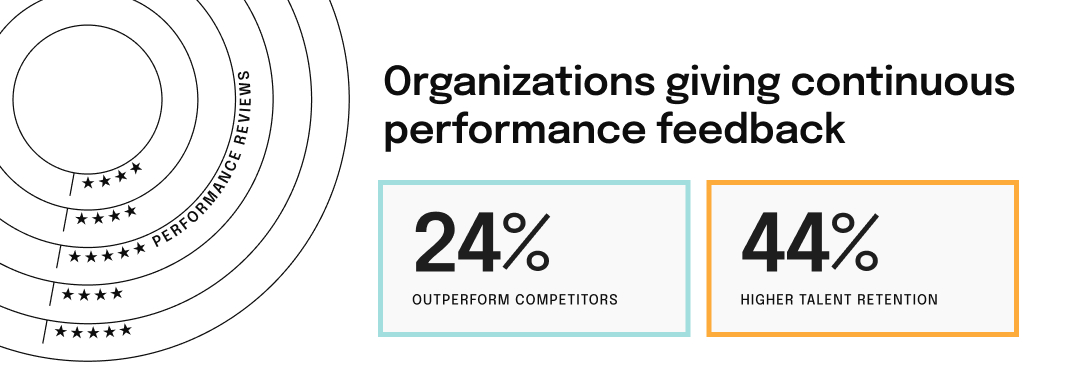
Many organizations don’t have enough feedback, and what they do have is too infrequent to be useful. Annual reviews give people one data point per year and ask them to improve based on it. Research shows organizations using continuous performance feedback outperform competitors at a 24% higher rate and retain talent at a 44% higher rate.
Start by adding one recurring touchpoint: a weekly check-in between managers and their direct reports, a team debrief after every major project, or a structured quarterly conversation tied to goal progress. The format matters less than the consistency. Continuous feedback has to be a rhythm before it can drive improvement.
Ground assessments in clear goals
An assessment tells you where someone is. A goal tells you where they need to be. Without both, the data has no context, and the feedback has no direction. Organizations that skip goal alignment before deploying assessments often end up with rich data they don’t know how to act on.
SMART goals, Specific, Measurable, Achievable, Relevant, and Time-bound, give assessments a frame of reference. Set goals at the individual, team, and organizational levels before running any assessment. Then use the assessment data to measure the gap between where people are and where the role requires them to be.
Develop around real skill gaps
Many organizations don’t have a clear picture of where their workforce is falling short. They have a sense of it, based on manager feedback and performance reviews, but not the data to act on it with confidence. Skill gap analysis changes that. Competency assessments compare current capability against what strong performance actually requires in a given role, giving leaders a specific, actionable view of where development is needed.
The World Economic Forum projects that 39% of workers’ core skills will need to change by 2030. Organizations that identify and close gaps proactively will be better positioned as those changes arrive. Start with the roles where performance variability is highest. Identify the skills your top performers have that average performers don’t. Build development investments around closing that specific gap.
Assess team dynamics, not just individual performance
Technical ability only explains part of how teams perform. Communication styles, personality traits, and work preferences shape how people collaborate, how conflict gets handled, and how well a team holds up when conditions change. Two people with identical skills can produce very different outcomes depending on how they’re wired to work together.
When leaders understand how each person on a team is wired, they can make smarter decisions about role assignments, collaboration structures, and where friction is likely to emerge. The Talexes ESA and TPS are designed to give leaders exactly that visibility, so they can build teams more intentionally.
Treat engagement as a leading indicator
Most organizations measure performance outcomes. Fewer measure the conditions that produce them. Engagement is one of those conditions. When employees feel supported, developed, and clear on their role, performance follows. When they don’t, it erodes quietly before the numbers reflect it.
Gallup research found that only 30% of employees believe someone at work actively encourages their development. Regular engagement measurement through pulse surveys, structured one-on-ones, and 360-degree feedback gives organizations visibility into those conditions before they become problems. When the data surfaces a gap, act on it within the same quarter.
Invest in leaders who model improvement
Culture is set from the top. Leaders who reflect openly on decisions, acknowledge what they’re still learning, and seek feedback from their teams create environments where improvement is normalized. Leaders who don’t create environments where people play it safe, and problems go unreported.
Start with a leadership assessment to establish a baseline. Tools like the TLA and Talassure360 show where leaders are building an improvement culture and where they’re undermining it. Use that data to prioritize coaching, not to evaluate performance. Leaders who can see their own blind spots clearly are less likely to let those blind spots shape their teams.
Bottom line: improvement is a process
A continuous improvement culture doesn’t emerge from a values statement or an annual offsite. It’s built through consistent systems: regular feedback, clear goals, honest skill gap analysis, and leaders who practice what they expect from others. The organizations that do it well don’t wait for a performance problem to prompt action. They build before they need it.
At Talexes, we help organizations build the systems that make continuous improvement possible, from smarter hiring to stronger development and more effective leadership. If you want to see what that looks like in practice, let’s talk.

