For decades, the dominant model of workplace learning involved pulling people out of their day, putting them in a room or on a webinar, delivering content, sending them back to work, and hoping something sticks. It was designed for a slower world, one where you could afford to stop operations for a day, where the skills people needed stayed relevant long enough for a once-a-year program to matter, and where completing the training was considered evidence that people were growing.
That world is gone. U.S. companies spent $98 billion on training in 2024 — and most of it evaporated faster than anyone would like to admit. The organizations navigating today’s pace of change, the complexity of hybrid work, and the pressure to show real return on every dollar spent can’t wait for the next training cycle. They need people to get better in real time, on real problems, without constantly stepping out of the work to do it.
That’s the problem learning in the flow of work is designed to solve.
From learning as an event to learning as part of the work
Most people have experienced the frustration of attending a solid training and watching the insights fade by the following week. It’s not a motivation problem. It’s a design problem. Research on the Ebbinghaus Forgetting Curve shows that people forget 50% of new information within an hour, 70% within 24 hours, and up to 90% within a week. Without reinforcement at the moment of application, training doesn’t stick — it dissolves.
The Center for Creative Leadership’s 70-20-10 research makes the design problem even clearer: 70% of development happens through on-the-job experience, 20% through relationships and feedback, and just 10% from formal training programs. Yet most organizations still invest the bulk of their learning budget in that 10%.
Learning in the flow of work corrects that imbalance. Rather than building knowledge in advance and hoping people remember it when the situation arises, you put the right resource, framework, or coaching touchpoint directly at the moment the situation is actually happening. A manager about to deliver difficult feedback pulls up a one-page conversation guide, not because they were trained on it six months ago, but because it’s sitting right where they need it. A new sales rep reviews a quick reference before their first discovery call. A team pauses at the end of a project to ask what they’d do differently and records it somewhere useful.
The result isn’t just better retention. It’s the difference between knowing something and actually doing it, which is where most training investments quietly disappear.
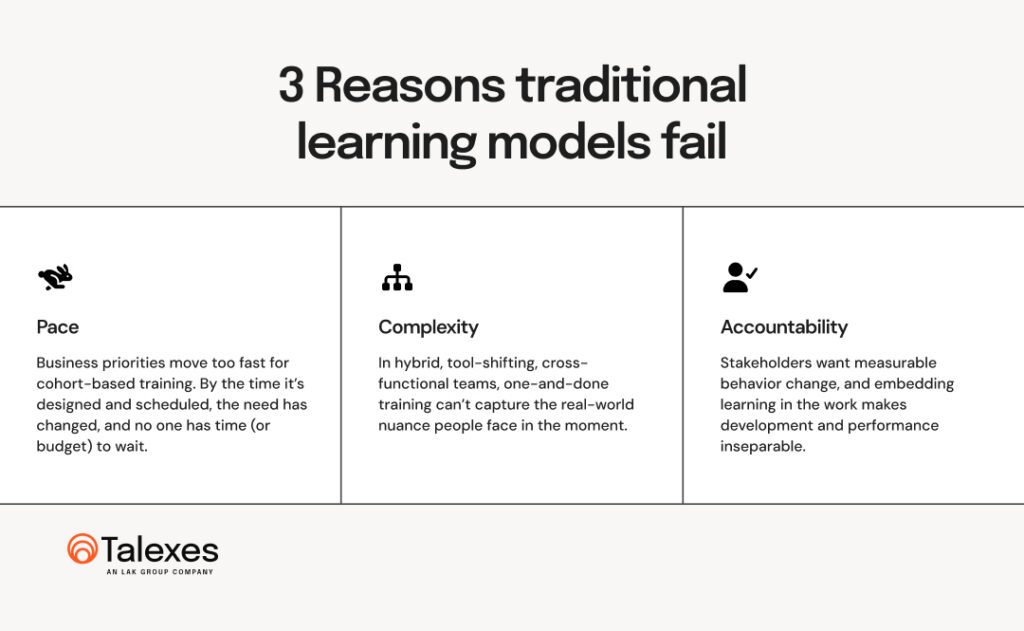
Three reasons traditional learning models fail
The pressure to rethink workplace learning isn’t coming from one direction. Three forces are converging at the same time, and together they’ve made the traditional training model genuinely inadequate, not just inefficient.
Pace. Business priorities shift faster than training calendars can follow. By the time a program is designed, approved, and scheduled, the need has often moved. People don’t have the margin to step away for extended development, and organizations can’t afford to wait for the next cohort to form.
Complexity. Hybrid teams, constantly evolving tools, and cross-functional work mean the right way to handle a situation is highly contextual. A course delivered once, even a good one, can’t account for the specific nuance someone encounters on a Tuesday afternoon six months later.
Accountability. Stakeholders no longer accept attendance as a proxy for impact. They want behavior change and measurable results. When learning is embedded in the work itself, connecting development to performance becomes straightforward because they’re happening in the same place, at the same time.
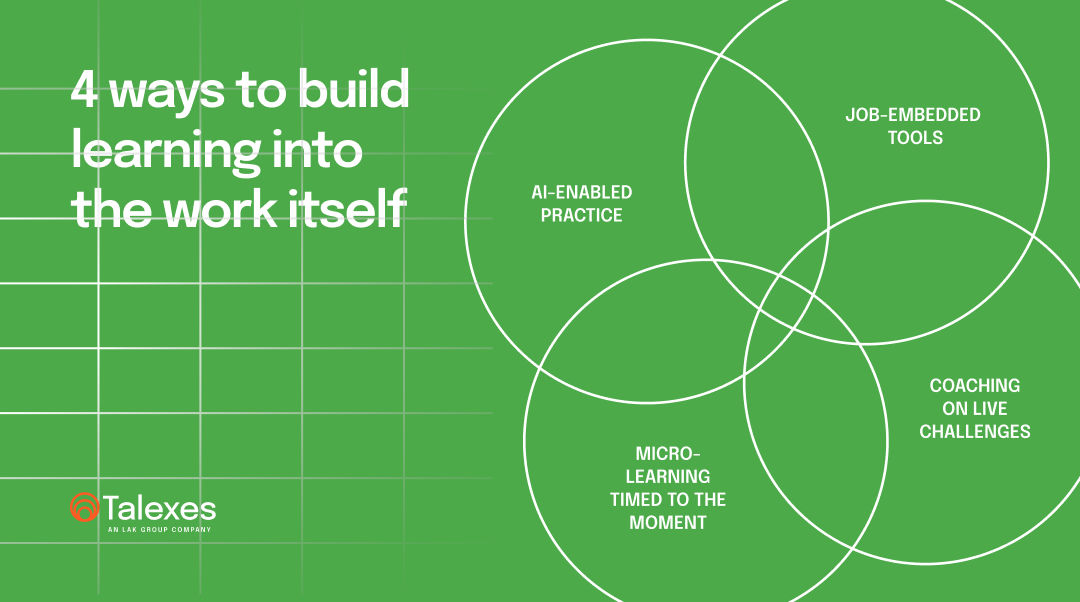
Four ways to build learning into the work itself
Shifting to this model doesn’t require scrapping what already exists. It requires adding learning infrastructure at the moments that matter most. Most organizations find traction in some combination of these four approaches.
Job-embedded tools. Reference guides, conversation frameworks, and quick-decision checklists are resources designed to be pulled up before a high-stakes moment, not filed away after a training session. The simpler and more accessible they are, the more likely people actually use them.
Coaching on live challenges. Rather than scheduled programs, coaches work with people on real problems in real time: preparing for a specific conversation, debriefing a difficult decision, identifying what to do differently next week. The work itself becomes the curriculum, and every challenge becomes a development opportunity. Assessments can make coaching more precise by helping leaders and coaches see where someone’s strengths, blind spots, and development needs are most likely to show up in the work.
Micro-learning timed to the moment. Short, focused content delivered before a relevant task creates immediate relevance in a way that quarterly training blocks don’t. “Before your next performance conversation” prompts action. “Complete by end of Q2” does not.
AI-enabled practice. Generative AI tools can help leaders rehearse conversations, draft feedback, and stress-test their thinking before the actual moment arrives. Used well, they extend the reach of coaching without replacing the human element, giving people a low-stakes environment to work things out before the stakes are real.
Create a top-down culture of learning
You can build excellent tools and design thoughtful touchpoints, but if leaders treat reflection as optional, something to get to when there’s time, none of it will take hold. The culture around learning matters as much as the infrastructure for it.
Consider this: Nearly 60% of first-time managers never received any formal management training before stepping into the role. They’re expected to develop their people without ever having been developed themselves. The result is a leadership culture that defaults to doing rather than reflecting, executing rather than learning.
When leaders consistently pause after decisions to ask what they’d do differently, name what they’re still working on, and invite honest feedback from their teams, they send a clear signal that getting better is part of the job, not a departure from it. That kind of culture becomes even stronger when reflection is paired with tools that make development more specific. Assessments, for example, can help leaders better understand how they show up, where they are most effective, and where blind spots may be getting in the way. Instead of relying on instinct alone, they have a clearer view of what to work on and how to grow.
And employees notice. 94% of workers say they would stay longer at a company that actively invests in their development. When leaders model that investment daily, the message lands in a way that an annual training calendar never could. When development is also personalized through timely feedback, coaching, and clearer insight into individual growth areas, employees can see that growth is not theoretical. It is part of how the organization operates.
How to start learning in the flow of work
The organizations that do this well didn’t redesign everything at once. They identified one place where people consistently felt underprepared, where the gap between what people knew and what they actually did was costing something real, and they built something useful for that moment.
Pick yours. It might be onboarding, performance conversations, sales calls, or project kick-offs. Ask what would actually help someone show up better in that specific situation, then build the simplest version of that support. Run it with a small group, find out whether it helped in the moment, and refine from there. The goal isn’t a perfect system on day one. It’s a learning environment that improves continuously, rather than one that resets every training cycle.
Development shouldn’t live outside the day
The organizations building the strongest teams aren’t always the ones with the biggest training budgets or the most sophisticated learning management systems. They’re the ones that have figured out how to make every meeting, every decision, and every challenge count as a development opportunity, where getting better isn’t a program people attend but something that happens in the work itself.
Learning in the flow of work isn’t a technology or a vendor category. It’s a design principle. Put learning where the work is, and the work gets better.
At Talexes, we believe hiring and development decisions should be grounded in insight, not guesswork. We use science-backed, workplace-focused assessments and talent solutions to help organizations hire the right people, develop stronger leaders, and build teams that perform better over time. Interested in testing out one of our assessments? The first one is on us.